
Datasan Labs
Datasan Labs · Operations automation

Still running
important processes
through spreadsheets
and email?

We turn that into software.

Built by a former bank regulatory-reporting and automation lead. MS in Applied AI.

Start with one process A short form, a real conversation, and an honest answer either way.

Does this sound familiar

Six sentences we hear in almost every first conversation.

“We have this spreadsheet…”

It started as a quick fix. Now three people maintain it and part of the business runs on it.

“Only Sarah knows how to do it.”

One person is a single point of failure for something the company can't stop doing.

“The systems don't talk to each other.”

So somebody exports from one and types it into the other. Every day.

“It takes two days every month.”

The same report, rebuilt from scratch, by someone whose time is worth considerably more than that.

“Someone has to review every single one.”

Hundreds of documents, forms or applications, each needing a pair of eyes on the same five fields.

“We tried Zapier, but…”

The process has exceptions, approvals and judgment calls in it. It outgrew the no-code tools a while ago.

If two or three of those sounded like a Tuesday, that's the work we do. If none of them did, you probably don't need us, and we'd rather say so now.


What it's costing you

We work out that number before anyone talks about building something.

Two people, twelve hours a month each. A manager reviewing for five more. That's already tens of thousands a year in salary spent on copying and checking, before you count the invoices that went out late, the errors somebody had to unwind, the hire you made partly to absorb the workload, and the fact that everything stops when one person is on holiday.

Most businesses have never added it up. We do it in the first conversation. If the number doesn't justify building anything, we'll tell you — that's a perfectly good outcome, and it's a much cheaper way to find out.

How we work

Four steps, and you can stop after any one of them.

i. The conversation

Forty-five minutes on how the work actually happens today. Who touches it, where the data comes from, what takes longest, where mistakes happen, who signs off. No pitch. It sometimes ends with us saying you don't need custom software.

ii. The assessment

We map the process properly and write it down: the current workflow, the manual steps, the bottlenecks, what could be automated, what should stay human, and what it's worth. That document is yours whether or not you build anything with us.

iii. One pilot

A single process. Scoped tightly, priced up front, with acceptance criteria agreed before we start. Not a platform, not a transformation — one thing that works and can be measured against what it replaced.

iv. Then, only if it earned it

The next workflow. Another department. Ongoing support. We'd rather earn that later than write it into the first contract.

Three examples

Different businesses. The same problem underneath.

A lawyer reviewing a document with a client across her desk.
A law practice

Every file searchable, and the intake that used to eat an afternoon.

Today
  1. client emails documents
  2. paralegal opens each one
  3. keys details into the practice system
  4. chases what's missing
  5. files it
  6. hopes someone can find it in eighteen months
Half a day per new matter
After
  1. documents arrive
  2. fields extracted and checked against the firm's rules
  3. anything doubtful goes to a review queue
  4. filed, indexed, searchable
Minutes per matter, review only

The lawyer still makes every judgment. The system just stops her paying someone to retype what the PDF already says.
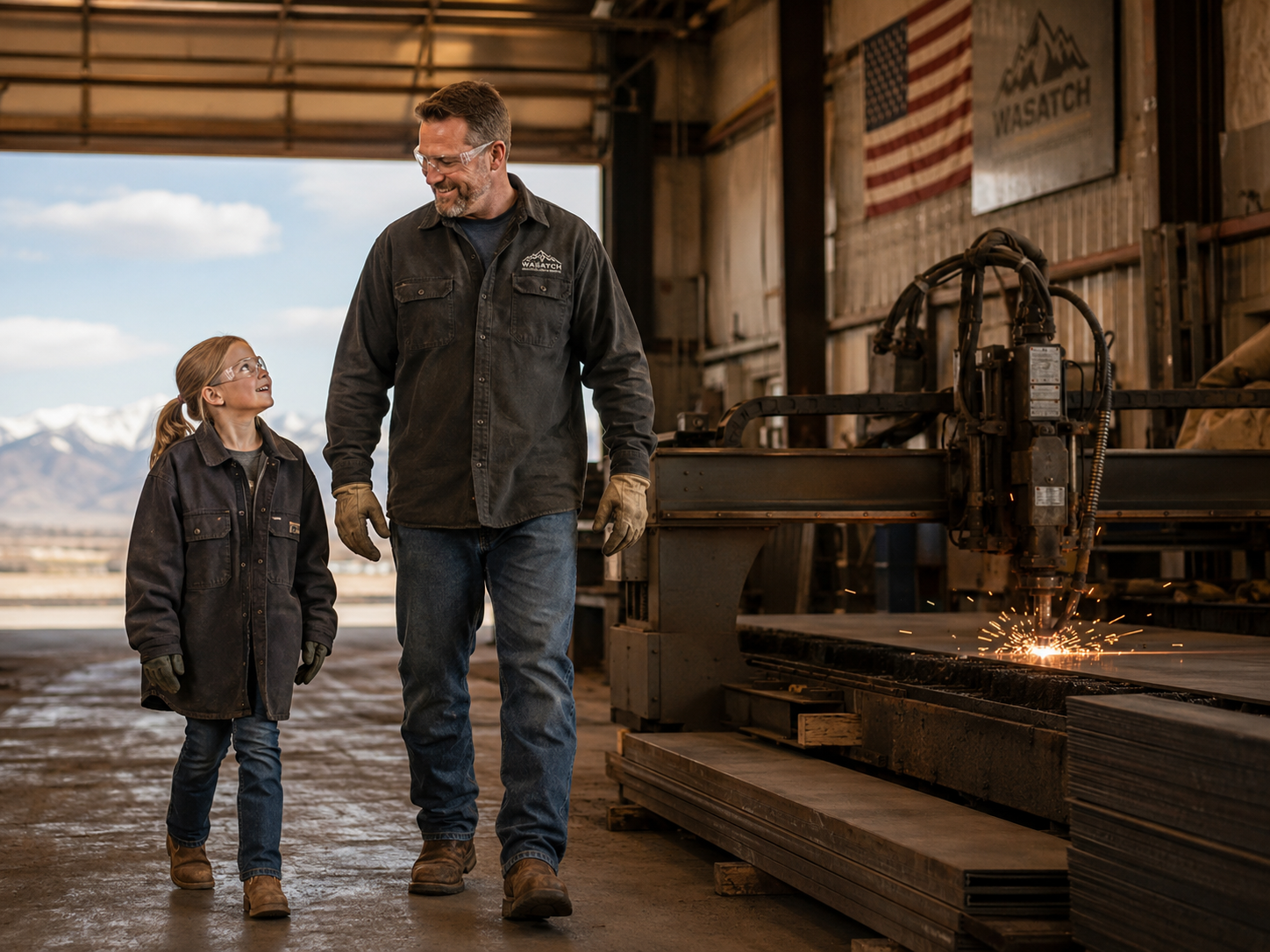

A father and daughter walking through a metal fabrication shop.
A machine shop

What's on the rack, what's promised, and what's about to be late.

Today
  1. whiteboard
  2. job folder
  3. shared spreadsheet
  4. phone call to the floor
  5. someone updates the sheet at the end of the day
  6. nobody's quite sure
And only Dave really knows
After
  1. orders in
  2. status tracked as work moves
  3. slipping jobs flagged before the customer calls
  4. one screen the whole shop reads
And it still works when Dave's on holiday

Ask what happens when the person who runs that spreadsheet goes on vacation. If the room goes quiet, that's the project.

A director at a desk in front of architectural plans and a building model.
A construction firm

Field reports in, approvals out, invoices that don't wait a week.

Today
  1. photos and notes from site
  2. emailed as PDFs
  3. retyped into a spreadsheet
  4. PM reviews
  5. forwarded for approval
  6. someone builds the invoice
  7. billing goes out late
A week of lag on every job
After
  1. field report submitted
  2. data extracted and validated
  3. exceptions to the PM
  4. approval in one click
  5. invoice generated with the backup attached
Same day

Email was never a workflow system. It's just the one everybody already had.

See what we build The four kinds of work we take on.
A small group kayaking on the bay with a city skyline in the distance.

A Saturday nobody spent rebuilding the spreadsheet.

Built for trust

Anyone can build software now. The question is whether it holds up.

Our work gets used at 8am on a Tuesday by people who didn't ask for it, and reviewed by the person who has to sign off on the output. We build expecting both.

01 / Judgment first

We don't force AI into it.

Plenty of consultants start with "how can we use AI here?" We start with how the process should work. Sometimes the answer is a rules engine, a scheduled job and a database. Models get used where they genuinely help — reading documents, classifying exceptions, matching messy names — and we'll tell you which parts didn't need one.

02 / Proof

Tested against what you already do.

We run the new system against your existing output before you rely on it. If it can't reproduce the results you already know are correct, it isn't finished. That's not a nice-to-have — it's the difference between software you use and software you quietly stop trusting.

03 / Data

Your data stays yours.

We deploy into your environment, with your keys. Confidential information doesn't get posted to a model API and hoped for the best. Where a step genuinely needs a model, we tell you which one, what it sees and what it keeps — and if a requirement can't be met, we say so instead of papering over it.

04 / Handover

You own it, and it outlives us.

The code, the configuration, the documentation. Built so another engineer could pick it up, and so it keeps running when the person who understood it best is on holiday — which was probably the original problem. We'd rather earn the next engagement than trap you in this one.

Ten years inside banks, where being wrong was expensive and somebody audited the work. Ask the hard questions early — that part we're good at.

A parent and child mountain biking on a trail in the mountains.

What the thirty hours a month were for.

Get in touch

Tell us about the process.

Which one would you stop doing by hand tomorrow, if you could? Roughly how it works, and what it costs you now. We read every one, and we don't take every project.

A short form, a real conversation, and an honest answer either way.

Thank you, friend.

We've got it. Someone here will read this carefully and write you back within two business days. No template, no follow-up sequence.